
Cheshire · Mouse & Rat Control
Mouse & Rat Control in Cheshire
Local, fully insured technicians covering Cheshire. Same-day and next-day appointments where available.
Cheshire
Get your free Cheshire quote
Call 0330 058 5472 for Cheshire, or send an enquiry and we will be straight back.
- Covered by our local Cheshire team
- Same or next day where available
- Honest, upfront pricing
Mice Pest Control provides mouse & rat control throughout Cheshire. Our local technicians know the area, respond quickly, and back every treatment with a clear guarantee.
01606 is the Northwich/Winsford dialling code; bedbugs labels the town Warrington (actually 01925). Number identical across sites.
Mouse or rat? How to tell what you are dealing with
The treatment plan changes completely depending on which rodent you have, so identification is the first job. The quickest tell is the droppings. Mouse droppings are small, dark and pointed at both ends, roughly the size of a grain of rice and scattered widely along runs. Rat droppings are noticeably bigger, sausage-shaped and blunter, and tend to cluster in concentrated spots. The noise differs too: mice make rapid, light scratching, while rats produce a heavier, more deliberate scurry and sometimes a teeth-grinding chatter known as bruxing. If you are unsure, a technician can confirm the species in minutes from the physical evidence, and we genuinely do get called out to surveys that turn out to be one rather than the other.
- Mouse droppings: 3 to 6 mm, pointed both ends, spread along runs and inside cupboards.
- Rat droppings: 12 to 20 mm, blunt, dark and grouped in concentrated piles.
- Mice: fast, light scratching, often high up in cavity walls and lofts.
- Rats: heavier movement under floors and decking, plus bruxing (teeth-grinding) when settled.
House mouse, field mouse, brown rat, black rat
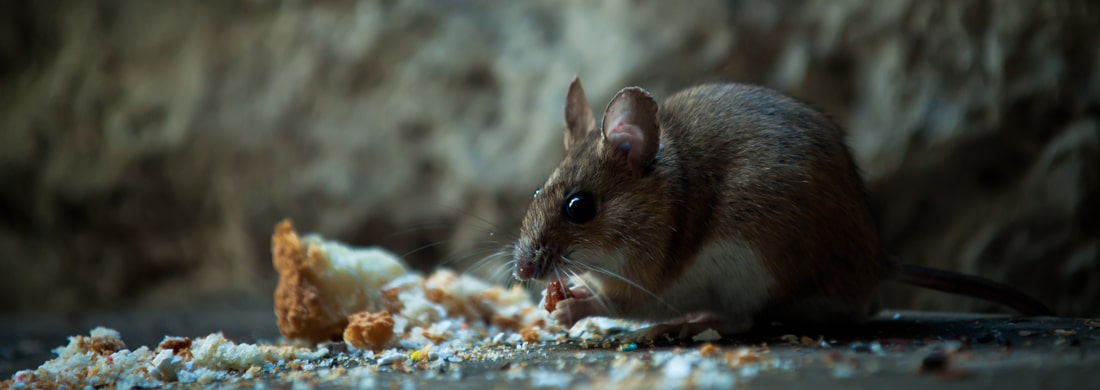
It is not just mice versus rats. The species within each matters. The house mouse turns up nationwide in town and country, has small ears and a slim tail, and squeezes through gaps a rat could never use, so it favours cavity walls, the backs of kitchen units and loft insulation. The field mouse (wood mouse) is a rural visitor with markedly larger ears and eyes for its size, and it tends to move indoors in autumn when the fields turn cold. Among rats, the brown rat dominates the UK: a cautious burrower that nests under decking, sheds, compost heaps and along drain runs before slipping in at ground level. The black rat is now rare, confined mostly to ports, and is a climber rather than a burrower, which is why it shows up in roofs and upper floors. A technician reads these differences on site and places treatment where that particular animal will actually find it.
- House mouse: nationwide, slips through a 6 to 7 mm gap, nests in walls and units.
- Field mouse: rural, larger ears and eyes, comes indoors as autumn cools.
- Brown rat: the common UK rat, a ground-level burrower drawn to decking and drains.
- Black rat: rare, port-associated, a climber that favours roofs and lofts.
The signs worth checking for tonight
Rodents are secretive and mostly nocturnal, so the evidence usually appears before the animal does. Beyond droppings and night-time noise, look for gnaw marks on skirting, cables, food packaging and pipe lagging, because both mice and rats must wear down continuously growing teeth. Greasy smear marks build up along skirting and pipework where rats run the same route on dirty fur. Nests of shredded paper, fabric or insulation appear in dark, undisturbed corners. A stale, ammonia-like smell collects under units and in roof voids. If you suspect activity but cannot confirm it, the old detection trick still works: scatter a little fine flour or talcum powder across a suspected run after dark and check at first light for foot and tail-drag prints. A change in your cat or dog, suddenly fixated on one spot of wall or skirting, is often the earliest clue of all.
- Gnaw marks on woodwork, cables, packaging and pipe insulation.
- Greasy smear marks where rats run repeated routes.
- Nests of shredded paper, fabric or loft insulation in quiet corners.
- A flour or talc test across a run, read the next morning, to confirm an active route.
Cheshire
Towns we cover in Cheshire
- Warrington
Good to know
Cheshire, common questions
How do I know whether I have mice or rats?
Droppings are the giveaway. Mouse droppings are small, around 3 to 6 mm, dark and pointed at both ends, and tend to be scattered along runs and inside cupboards. Rat droppings are much larger, around 12 to 20 mm, blunter and grouped in concentrated piles. The sound helps too: mice produce rapid, light scratching while rats make a heavier scurry. If you are still unsure, send a technician a photo or book a survey, and the species can usually be confirmed in minutes from the physical evidence.
How are rodents getting into my home?
A mouse needs a gap only about the size of a pencil, roughly 6 to 7 mm, and a rat needs around 20 to 25 mm, about the size of a 50p coin. The usual entry points are gaps where water and gas pipes pass through walls, missing or damaged air bricks, gaps under external doors, holes where cables enter, redundant pipework openings left unsealed, and defective drainage for rats. Mice in particular will also come in higher up, through open eaves, damaged roofing or along branches that touch the roofline. Older properties have more weak spots, but newer builds often have unsealed gaps around utilities too.
Is rodenticide bait safe around pets and children?
Yes, when handled properly. The products we use are professional-grade and placed inside tamper-resistant, lockable bait stations designed to keep out children, pets and non-target wildlife. We site stations where rodents are actually active and away from areas of frequent human or pet contact, and we use trapping instead where bait is not appropriate. You will be told about any precautions specific to your property at the time of treatment, and we never simply scatter loose bait.
Can I just buy bait or traps from a shop and do it myself?
You can reduce a population that way, but DIY rarely finishes the job. Shop bait is sold at lower strength than professional products, snap traps catch one animal at a time while the colony keeps breeding, and rodents are wary of new objects, so the days they avoid a fresh trap are exactly when the numbers climb. Crucially, DIY does nothing about the entry points and harbourage that made your home attractive. Professional treatment is a survey, a treatment and a proofing job together, which is what actually stops the cycle.
Will rodents come back after treatment?
They can, but only if the gaps stay open. Rodents do not arrive at random; they follow scent trails, food and established routes. If the entry points that allowed the first infestation are still there, new animals will find them, often the following autumn. Proofing is what prevents that, which is why we treat it as part of the job rather than an optional extra, and why we will come back to seal an entry point we missed without adding it to your bill.
Why does the approach differ for mice compared to rats?
Because their behaviour does. House mice are inquisitive and will explore new objects readily, nesting close to food inside walls and under appliances, which makes correctly sited traps and bait effective quickly. Brown rats are larger, cautious and neophobic, avoiding anything unfamiliar for days, and they prefer to burrow outdoors before entering at ground level. Rats also have a social pecking order where a dominant animal can keep others off a bait station. A technician who reads these differences places treatment where each species will genuinely take it, rather than applying one method to both.
Mice problem in Cheshire?
We can usually be out the same or next day. Speak to the team now.